Why Your Physical Therapist Should Be Your First Call — Not Your Last
Here's how most people end up in physical therapy: they get hurt, they rest, they try a heating pad, they Google their symptoms at midnight, they take some ibuprofen for a few weeks, maybe they see their primary care doctor who orders an X-ray, possibly get a referral to an orthopedic specialist — and somewhere in that months-long journey, someone finally says "have you tried physical therapy?"
By that point, the original injury has often been compounded by weeks or months of compensatory movement patterns, deconditioning, and — in some cases — unnecessary imaging, injections, or even surgery that might have been avoided entirely.
The standard sequence is backwards. And it's costing patients time, money, and a harder recovery than they needed to have.
You Don't Need a Referral to See a Physical Therapist
One of the most persistent myths in healthcare is that you need a doctor's referral before seeing a PT. In South Carolina — and most of the United States — that's not true. Physical therapists are licensed primary care providers for musculoskeletal conditions. You can call, book, and be seen without a physician visit first.
This is called direct access, and it's one of the most underutilized advantages in the current healthcare system. It means that when you tweak your back, reaggravate a shoulder injury, or feel that familiar tightness that always precedes a bigger problem — you can get in front of a doctoral-level clinician the same week, without navigating a referral chain.
At Ascent Total Performance, no referral is needed. If you're hurting, you can book directly. We'll handle the rest — including coordinating with your physician or specialist when it's clinically appropriate.
What Waiting Actually Costs You
The instinct to "wait and see" is understandable. Most minor aches do resolve on their own. But when something doesn't resolve — or keeps coming back — every week of delay has a compounding effect on how long and how hard your recovery will be.
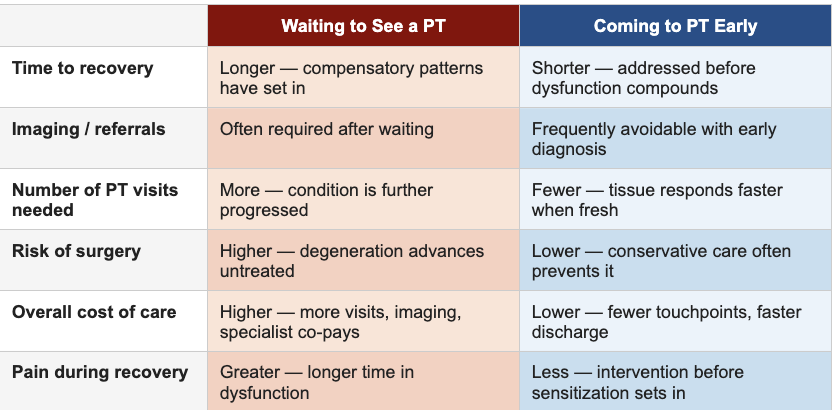
This isn't a scare tactic. It's biomechanics. When one area of the body isn't functioning correctly, surrounding structures compensate. Those compensations become movement habits. Those habits load tissue in ways it wasn't designed for. What started as a manageable issue becomes a pattern — and patterns take longer to unwind than the original injury.
A Physical Therapist Can Tell You What's Actually Wrong
Physical therapists are trained in differential diagnosis for musculoskeletal conditions. That means when you come in with knee pain, your DPT isn't just treating knees — they're evaluating your hip mobility, ankle mechanics, foot strike pattern, quadriceps-to-hamstring strength ratio, and movement quality under load to find out where the problem is actually coming from.
In many cases, this assessment alone is more informative than an X-ray or MRI. Imaging tells you what a structure looks like at rest. A movement assessment tells you how your body is actually functioning under the demands you're placing on it. These are different questions — and for most musculoskeletal complaints, the movement question matters more.
At ATP, every patient starts with a thorough evaluation by a Doctor of Physical Therapy before any treatment begins. We don't hand you a generic exercise sheet based on your chief complaint. We diagnose what's driving your symptoms, build a plan around that specific finding, and explain it to you clearly so you understand what's happening in your own body.
When "Just Rest" Is the Wrong Prescription
Rest has its place — particularly in the acute phase of a significant injury. But rest is also one of the most overprescribed recommendations in musculoskeletal care. For the majority of conditions, controlled movement and early loading are more effective than rest for driving tissue healing, reducing pain sensitization, and restoring normal function.
The research on this is not subtle. Early mobilization after sprains, strains, rotator cuff injuries, low back episodes, and post-surgical recovery consistently outperforms passive rest in both short-term and long-term outcomes. The body heals by moving — the right movements, at the right intensity, at the right time.
A physical therapist's job is to prescribe exactly that. Not generic movement, not "just take it easy," but specific, progressive loading calibrated to where your tissue is in its healing timeline and where it needs to go.
Rest stops pain. Movement restores function. One of those gets you back to doing what you love.
PT Can Help You Avoid Surgery — Or Get Better Outcomes If You Need It
For many conditions that commonly lead to surgical referrals — rotator cuff tears, lumbar disc herniations, knee meniscus issues, plantar fasciitis, carpal tunnel syndrome — conservative physical therapy is the evidence-based first-line treatment. Surgery is appropriate when conservative care has genuinely failed, not as an early default.
The challenge is that many patients never get adequate conservative care before a surgical decision is made. They see an orthopedic surgeon — who by training and incentive structure is oriented toward surgical solutions — without having had a serious course of high-quality physical therapy first.
Equally important: for patients who do need surgery, pre-surgical physical therapy (often called "prehab") has been shown to significantly improve post-operative outcomes. Patients who come in stronger and with better movement quality before surgery consistently recover faster, require fewer post-op PT visits, and report better functional outcomes at six and twelve months. The work you do before surgery directly shapes the ceiling of your recovery after.
The Right Time to Call Is Before You Think You Need To
You don't have to be in significant pain to benefit from physical therapy. Some of the most impactful work we do at ATP is with patients who come in early — a nagging tightness that won't resolve, a movement that doesn't feel quite right, a recurring issue they've been managing around for months. These are exactly the presentations where intervention is most effective and recovery is fastest.
If you're active, athletic, or simply value staying capable and pain-free long term — building a relationship with a physical therapist before you're injured is one of the highest-leverage health investments you can make. Movement screening, injury risk assessment, and targeted strengthening can identify and address vulnerabilities before they become injuries.
That's the model ATP is built around. Not just rehabilitation. Ascent.
The Bottom Line
Physical therapy doesn't have to be a last resort. When you come in early — before compensation patterns set in, before imaging queues and specialist referrals, before a manageable issue becomes a chronic one — you recover faster, spend less, and protect your long-term function.
In South Carolina, you have the right to access that care directly, without a referral, on your timeline. The only thing stopping most people is not knowing it's an option.
Now you know.
📅 Don't wait until it's a bigger problem. Request your first appointment at achieveatp.com — no referral needed, no hoops to jump through.