What Is VO2Max Testing — And Should You Get One?
You've probably heard the term thrown around in endurance sports circles or seen it pop up on your smartwatch. But what does VO2max actually measure — and more importantly, what do you do with that number?
If you've ever felt like you're working hard but not seeing the performance gains you're after, or you've hit a plateau that no amount of extra training seems to break through, VO2max testing might be the missing piece. Here's what it is, how it works, and whether it makes sense for you.
What Is VO2Max?
VO2max is the maximum rate at which your body can consume oxygen during intense exercise. It's considered the gold standard measure of cardiovascular fitness and aerobic capacity — essentially a ceiling on how hard your body can work before it runs out of oxygen to fuel your muscles.
The "V" stands for volume, "O2" is oxygen, and "max" is exactly what it sounds like. The number is expressed in milliliters of oxygen per kilogram of body weight per minute (mL/kg/min). Elite endurance athletes typically score above 60. Well-trained recreational athletes usually fall in the 45–60 range. Most healthy adults land between 30–45.
Your VO2max isn't just a fitness score — it's a window into how efficiently your cardiovascular and muscular systems are working together under real demand.
VO2Max Is Becoming a Vital Sign — Here's Why
For years, doctors tracked five vital signs: heart rate, blood pressure, temperature, respiratory rate, and oxygen saturation. A growing body of research — and a shift in how forward-thinking clinicians approach preventive health — is pushing VO2max toward that same list.
The evidence is hard to argue with. A landmark study published in JAMA Network Open found that low cardiorespiratory fitness was a stronger predictor of all-cause mortality than smoking, hypertension, diabetes, or high cholesterol. Not slightly stronger — significantly stronger. Patients in the lowest VO2max category had a mortality risk 5x higher than those in the highest category.
Put simply: how well your body uses oxygen under effort may be the single most powerful indicator of how long — and how well — you'll live.
"Cardiorespiratory fitness is arguably the most important vital sign we have — and the most underutilized." — Consistent finding across longevity research, popularized by clinicians like Dr. Peter Attia in Outlive.
A few data points worth knowing:
Every 3.5 mL/kg/min increase in VO2max is associated with approximately a 13% reduction in all-cause mortality risk
Moving from "low" to "below average" fitness reduces mortality risk by roughly 50% — a greater reduction than most medications can achieve
VO2max naturally declines about 10% per decade after age 30 — but that decline is not fixed. Training can slow it dramatically, and testing gives you the baseline to measure against
The American Heart Association has formally recognized cardiorespiratory fitness as a clinical vital sign
This reframes what VO2max testing is about. It's not just a performance tool for athletes chasing a faster race time. It's a longevity tool for anyone who wants to understand where they stand today — and build a plan to stay active, capable, and healthy for decades to come.
At ATP, we see metabolic testing as a natural extension of physical therapy's core mission: not just getting you out of pain, but building the foundation for a longer, higher-performing life.
How Is VO2Max Testing Done?
A VO2max test is a graded exercise test — typically done on a treadmill or bike — where the intensity increases gradually while you breathe through a mask that measures the oxygen you're taking in and the carbon dioxide you're exhaling. The test continues until you reach maximum effort or can no longer sustain the workload.
At Ascent Total Performance, our VO2max testing is conducted one-on-one with a Doctor of Physical Therapy. That distinction matters — because the data alone is only half the value. What you do with it requires clinical expertise.
Here's what the test reveals:
Your VO2max score — your aerobic ceiling
Your lactate threshold — the intensity at which your body shifts from aerobic to anaerobic metabolism (critical for training zone precision)
Your ventilatory threshold — a real-time marker of how your breathing responds to increasing effort
Your heart rate response — how your cardiovascular system is adapting to load
What Is RMR Testing — And Why Does It Matter Too?
Resting Metabolic Rate (RMR) testing measures how many calories your body burns at complete rest — before activity, stress, or digestion are factored in. This is the number that forms the true foundation of any nutrition or body composition strategy.
Most calorie calculators use population-based formulas that can be off by 200–500 calories a day. That's the difference between making progress and spinning your wheels. An RMR test gives you your actual number — not a statistical estimate.
When combined with VO2max data, RMR testing gives you a complete metabolic picture:
How efficiently you burn fuel at rest
Which fuel sources (fat vs. carbohydrate) your body prefers at different exercise intensities
How to structure nutrition around your actual energy demands
Most people are training with the right effort but the wrong fuel strategy. RMR testing fixes that.
Who Should Get Tested?
VO2max and RMR testing aren't just for elite athletes — they're for anyone who is serious about understanding their body and wants to stop guessing. Here's a simple breakdown:
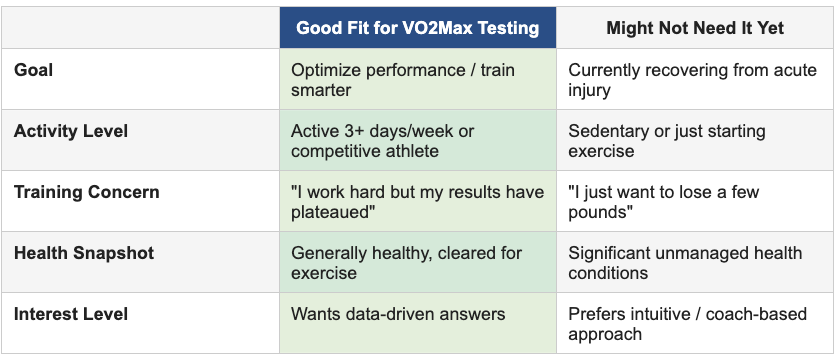
If you're training for a marathon, triathlon, competitive season, or simply want to perform better in the gym or on the field — testing gives you a data-driven starting point that no wearable device can replicate with the same accuracy.
Can You Improve Your VO2Max?
Yes — and significantly. VO2max is trainable, especially with the right approach. The most effective methods include:
High-intensity interval training (HIIT) — short, intense efforts that push your cardiovascular system to its ceiling
Zone 2 aerobic base training — sustained low-intensity work that builds mitochondrial density and fat-burning efficiency
Periodized programming — structured variation in intensity and volume that allows adaptation without overtraining
The problem most people run into is training in the wrong zones for their goals. Without knowing your actual lactate and ventilatory thresholds, you're essentially guessing at what "hard enough" means. VO2max testing removes that guesswork entirely.
At ATP, your test results come with a personalized interpretation from a DPT — including specific heart rate training zones, recommendations for your current program, and guidance on what to prioritize based on your goals.
What to Expect at Your Appointment
The full metabolic testing session at Ascent Total Performance takes approximately 90 minutes and includes both VO2max and RMR testing. Here's the general flow:
RMR test first — done at complete rest, lying down, typically 15–20 minutes
Baseline assessment — health history, current training, and goals review with your DPT
VO2max test — graded exercise protocol with continuous metabolic monitoring
Results review — your DPT walks through every data point and builds your personalized training zones and recommendations
Come fasted (3–4 hours) for the RMR test, wear comfortable workout clothes, and plan to exercise at maximum effort during the VO2max portion. Avoid heavy training the day before.
The Bottom Line
If you've been training hard without a clear picture of how your body is actually responding — VO2max and RMR testing gives you that picture. It's not a luxury reserved for professional athletes. It's a practical tool for anyone who wants to train with intention, fuel with precision, and stop leaving performance on the table.
At Ascent Total Performance in Columbia, SC, metabolic testing is conducted one-on-one with a Doctor of Physical Therapy who will interpret your results and build a plan around them. Not just numbers on a page — an actionable roadmap.
📅 Ready to find out exactly where you stand? Book your VO2Max & Metabolic Testing session at achieveatp.com — one-on-one with a Doctor of Physical Therapy.