ACL Recovery: What a Real Timeline Looks Like
An ACL tear is one of the most common — and most feared — injuries in sport. The surgery has become routine. The recovery has not.
Most athletes know the rough timeline: six months to a year. What they don't know is how much the quality of that recovery depends on what happens inside that window — and how much variation there is between a program that gets you back to full performance and one that simply gets you back to cleared.
At Ascent Total Performance, ACL rehabilitation is one of the most intensive, data-driven programs we run. Here's an honest look at how we approach it — and why the details matter far more than the calendar.
The Problem with "Standard" ACL Rehab
The traditional ACL rehab model was built around tissue healing timelines — rest the graft, protect the knee, gradually reintroduce movement. That model has improved significantly over the past decade, but it's still widely underdelivered in practice.
The most common failures we see in athletes who come to us after suboptimal rehab elsewhere:
Significant quad muscle atrophy that was never fully addressed — often because early loading was too conservative or BFR was never used
Cleared for return to sport based on time elapsed, not objective testing — no limb symmetry data, no force plate assessment, no movement quality evaluation
No psychological readiness component — athletes who are physically capable but haven't been progressively reintroduced to the movements that caused the original injury
Re-injury rates that remain unacceptably high — studies consistently show 15–25% re-tear rates within two years of return to sport, with rates approaching 30–40% in young athletes returning to cutting sports
That last statistic is the most important one. A recovery that ends in re-tear isn't a recovery. The bar for ACL rehab shouldn't be "cleared by the surgeon." It should be "returned to full performance with confidence and meaningfully reduced re-injury risk."
Time alone does not determine readiness. Objective data does. At ATP, athletes don't return to sport because the calendar says so — they return because the testing says so.
Why Blood Flow Restriction Training Changes Everything in the Early Phases
One of the most significant advancements in ACL rehabilitation over the past decade is the systematic integration of Blood Flow Restriction (BFR) training — and it has fundamentally changed what's possible in the early weeks of recovery.
Here's the challenge BFR solves: in the first weeks after ACL reconstruction, the graft is at its most vulnerable. The load needed to stimulate meaningful muscle protein synthesis and prevent atrophy is too high to safely apply to the healing tissue. Traditional low-load exercise in this window doesn't create enough stimulus to stop the quad from wasting.
BFR uses a pneumatic cuff to partially restrict venous blood flow out of the limb during exercise. The result: metabolic stress and muscle activation at a fraction of the external load required by conventional training. You get the anabolic stimulus of heavy training with the joint stress of light rehabilitation exercise.
The clinical evidence is clear — BFR training in early ACL rehab:
Significantly reduces quad muscle atrophy in the first 4–8 weeks post-op
Accelerates strength recovery compared to standard early-phase protocols
Can be safely initiated within the first week post-surgery
Reduces the strength deficit that must be overcome in later phases, compressing the overall recovery timeline
At ATP, BFR is not an add-on — it's a core component of our ACL protocol from day one. The athletes who benefit most are those who come to us early, before atrophy has already set in and become the primary obstacle to recovery.
The ATP ACL Recovery Timeline
Every ACL recovery is individualized based on graft type, surgical approach, sport demands, and baseline strength. The timeline below reflects our general protocol framework — progression is always driven by objective criteria, not dates alone.
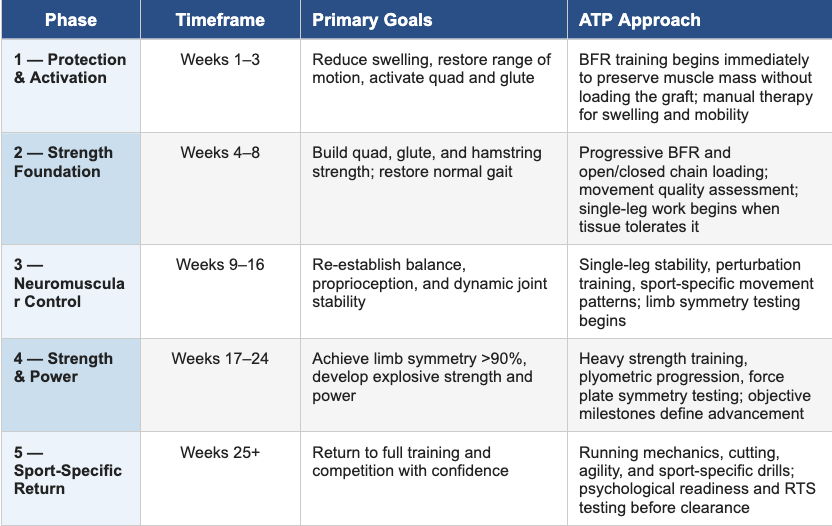
The most important principle running through every phase: advancement is earned, not assumed. An athlete who meets strength and movement quality benchmarks early can progress ahead of schedule. An athlete who hasn't yet met them stays in the current phase until they do — regardless of where the calendar says they should be.
Objective Testing: How We Know You're Actually Ready
The return-to-sport decision is the most consequential point in ACL rehab — and it's where the most shortcuts are taken in the broader healthcare system. At ATP, return-to-sport clearance is based on objective data, not clinical impression alone.
The criteria we use before clearing an athlete for full return:
Limb Symmetry Index (LSI) ≥90% for quadriceps and hamstring strength — measured on both legs to ensure the injured side has recovered proportionally
Single-leg hop test battery — four standardized hop tests comparing distance and power symmetry between limbs
Movement quality assessment — landing mechanics, cutting patterns, and deceleration control evaluated under sport-relevant conditions
Psychological readiness — using validated tools like the ACL-RSI (Return to Sport after Injury scale) to ensure the athlete is mentally prepared, not just physically cleared
Sport-specific load exposure — athletes complete sport-specific drills and practice scenarios before being cleared, not just gym-based testing
An athlete who passes all criteria has done the work. An athlete who doesn't yet meet them needs more time in the program — and that's not a setback, it's the system working correctly.
The Psychological Side of ACL Recovery Nobody Talks About
Fear of re-injury is the most underaddressed factor in ACL return to sport — and one of the strongest predictors of whether an athlete actually returns to their pre-injury performance level.
Research consistently shows that a significant percentage of athletes who are physically cleared after ACL reconstruction never return to their pre-injury sport — not because of physical limitation, but because of psychological hesitancy. They protect the knee. They alter their mechanics. They play tentatively. And in many cases, that altered movement pattern actually increases re-injury risk rather than reducing it.
At ATP, psychological readiness is built into the program — not addressed only at the end. Progressive exposure to the movements that caused the original injury, sport-scenario simulation, and explicit conversation about fear and hesitancy are part of every athlete's journey. The goal is an athlete who returns not just physically ready, but confident — moving the way they moved before, without the inhibition that makes re-injury more likely.
Physical clearance and psychological readiness are not the same thing. Both matter. We address both.
The Bottom Line
ACL recovery is a long road. The athletes who navigate it best aren't necessarily the ones with the best surgeons or the fastest timelines — they're the ones who commit to a high-quality rehabilitation program, meet objective benchmarks at every phase, and don't cut corners on the work that determines long-term outcomes.
At Ascent Total Performance, our ACL protocol integrates Blood Flow Restriction training, progressive strength and power development, objective return-to-sport testing, and psychological readiness assessment into a program designed not just to get you back on the field — but to get you back better.
📅 Facing ACL surgery or already in recovery? Request an appointment at achieveatp.com and we'll build a program around where you are and where you need to go.