Reclaim Your Fitness After Pregnancy: Why a Pelvic Floor PT Is the Expert You Need
As a new mom, you're eager to regain your pre-pregnancy fitness and strength. But for many women, the physical toll of childbirth makes that goal feel frustratingly out of reach. Pelvic pain, leaking with exercise, heaviness in your pelvis, or a core that just doesn't feel like yours anymore — these are real, common experiences that no one talks about enough.
And yet, the advice most women receive is some version of "wait six weeks, then get back at it." That guidance is not only incomplete — for many women, it's counterproductive.
That's where a pelvic floor physical therapist becomes your greatest ally in the journey back to your active, confident self. Unlike generic online workouts or advice from well-meaning influencers, we bring specialized doctoral-level training and a personalized clinical approach to help you return — safely and completely — to the activities you love.
1. You're Not Alone — And This Isn't Just "Part of Having a Baby"
Postpartum pelvic floor dysfunction is far more common than the fitness industry acknowledges. Research published in the American Journal of Obstetrics and Gynecology shows that approximately 1 in 3 women experience urinary incontinence following childbirth — and that number climbs higher in women who return to high-impact exercise without proper rehabilitation.
Diastasis recti (separation of the abdominal wall) affects an estimated 60% of women in the third trimester and persists in up to 40% at six months postpartum. Pelvic organ prolapse symptoms — heaviness, pressure, or a bulging sensation — affect as many as 50% of women who have delivered vaginally.
These are not inevitable consequences of motherhood. They are treatable conditions — and with the right intervention at the right time, most women recover fully.
The problem isn't that your body is broken. The problem is that most postpartum care stops at the six-week OB clearance, and most fitness professionals aren't trained to identify or address what's happening beneath the surface.
2. We Don't Just Look at Your Pelvic Floor
With a doctorate-level education and specialization in women's health rehabilitation, we take a comprehensive view of your postpartum body. The pelvic floor doesn't function in isolation — it's part of an integrated system that includes your diaphragm, deep abdominals, and spinal stabilizers. When one piece of that system is disrupted, everything else compensates.
Here's what a thorough postpartum assessment actually includes:
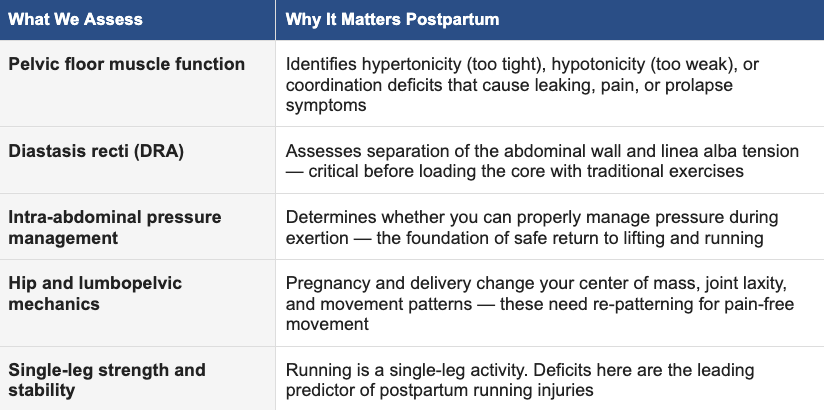
This holistic picture is what separates pelvic floor PT from everything else. We're not just doing Kegel exercises with you. We're understanding why your system isn't working and rebuilding it from the foundation up.
3. What Treatment Actually Looks Like
Armed with that assessment, we build a customized program around your specific deficits, your goals, and your timeline. No generic protocols — just a plan that reflects your body and what you're working toward.
Treatment may include:
Manual therapy to address muscle tension, scar tissue (including C-section or perineal scars), and joint mobility restrictions
Intra-abdominal pressure management training — learning to breathe, brace, and move in a way that protects your healing tissues during exertion
Progressive core rehabilitation that sequences from deep stabilizers outward — not crunches and planks from week one
Targeted strength training, including weightlifting, to rebuild the full-body power you need for high-level activity
4. The Evidence-Based Path Back to Running and High-Impact Exercise
The "six-week clearance" is one of the most misleading benchmarks in women's health. Research from the British Journal of Sports Medicine — the most widely cited postpartum return-to-running guidelines, authored by Groom, Donnelly, and Brockwell — recommends that women avoid running and high-impact exercise until at least 12 weeks postpartum, and only after meeting a specific set of physical benchmarks.
Those benchmarks aren't about the calendar. They're about what your body can actually do:
Walk briskly for 30 minutes without symptoms
Single-leg balance for 10 seconds without trunk deviation
Single-leg calf raises, bridges, and forward bounds without leaking or heaviness
Demonstrate adequate hip and lumbopelvic strength and mechanics
Returning to running before these criteria are met doesn't just risk short-term discomfort — it increases the likelihood of stress urinary incontinence, pelvic organ prolapse progression, and musculoskeletal injury from a body that hasn't yet rebuilt its structural foundation.
Here's how we sequence your return:
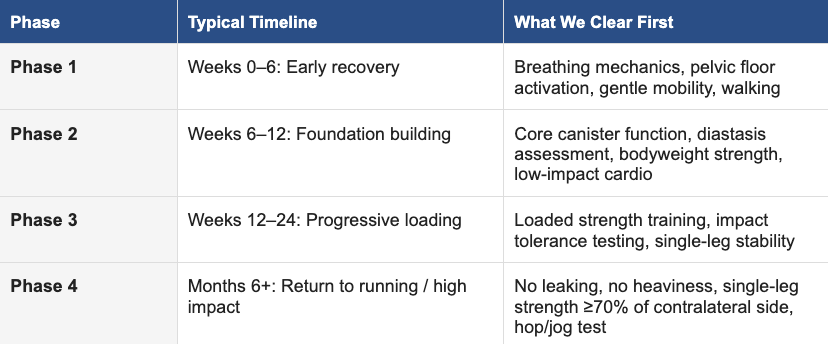
The goal isn't just getting you back. It's getting you back better — with a body that's more resilient, better coordinated, and better equipped for the demands of motherhood and athletic life than it was before.
5. A Partner Through Every Stage — Not Just the Fourth Trimester
Our role doesn't end when you hit your return-to-sport milestones. As your guide through every stage of motherhood and beyond, we provide the resources and clinical support to help you maintain optimal function for the long term.
That means pelvic floor-friendly workout programming as your training intensity increases, guidance on nutrition and recovery that supports your performance goals, and proactive strategies for pelvic health across the lifespan — because the same pelvic floor you're rebuilding now is the one that will carry you through perimenopause, menopause, and decades of active life.
Women who address pelvic floor dysfunction early and comprehensively have significantly better long-term outcomes for urinary continence, sexual function, and quality of life. The work you do now is an investment in a body that keeps performing.
Don't Wait to Feel Like Yourself Again
Whether your goal is to return to running, set new personal records in the gym, or simply have the energy and physical confidence to keep up with your little one without worrying about leaking — we will push you to get there. Evidence-based, results-driven, and completely personalized to you.
Don't let pelvic floor dysfunction be the thing that holds your fitness back. The six-week appointment isn't the finish line for postpartum care — it's just the beginning. Your body deserves a real evaluation and a real plan.
Schedule a consultation with our pelvic floor specialist today. Your future self will thank you.
📅 Ready to reclaim your strength? Request a pelvic floor consultation at achieveatp.com — no referral required.
RESEARCH REFERENCES
Groom T, Donnelly G, Brockwell E. (2019). Returning to running postnatal — guideline for medical, health and fitness professionals managing this population. British Journal of Sports Medicine.
Woodley SJ, et al. (2020). Pelvic floor muscle training for prevention and treatment of urinary and faecal incontinence in antenatal and postnatal women. Cochrane Database of Systematic Reviews.
Lee D, Hodges PW. (2016). Behavior of the linea alba during a curl-up task in diastasis rectus abdominis. Journal of Orthopaedic & Sports Physical Therapy, 46(7), 580–589.
Bø K, et al. (2015). Evidence-based physical therapy for the pelvic floor: bridging science and clinical practice (2nd ed.). Churchill Livingstone Elsevier.
Hagen S, Stark D. (2011). Conservative prevention and management of pelvic organ prolapse in women. Cochrane Database of Systematic Reviews.
Mørkved S, Bø K. (2014). Effect of pelvic floor muscle training during pregnancy and after childbirth on prevention and treatment of urinary incontinence: a systematic review. British Journal of Sports Medicine, 48(4), 299–310.